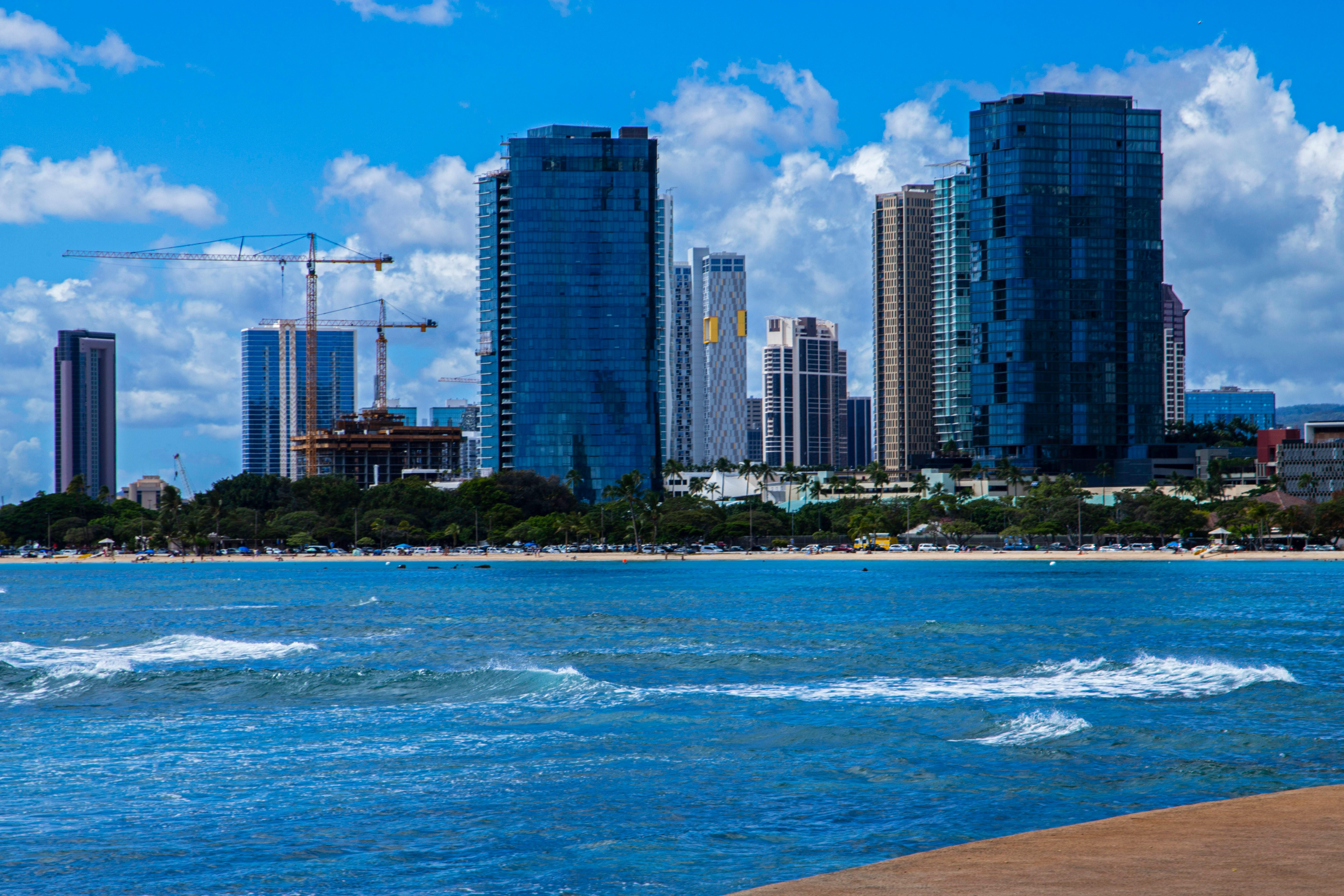
Hawaii is one of the more expensive states in the country for general liability insurance, and general liability insurance Hawaii rates often run 20% or more above the national average, putting the state in the same bracket as New York and California. Some of that is unavoidable. Construction costs on the islands run nearly 19% above the U.S. average, materials take 10 to 14 days to ship, and when claims happen they tend to cost more to resolve than the same incident would on the mainland. Insurers price all of that in.
But not everything driving your premium is outside your control. Five specific factors determine what you pay, and understanding them is the difference between overpaying and getting a rate that actually reflects your operation.
What General Liability Insurance Covers in Hawaii
General liability covers third-party claims for bodily injury, property damage, and personal or advertising injury that arise from your business operations. For a contractor in Hawaii, that plays out like this:
| What it covers | Example |
| Bodily injury | A visitor trips over tools on your jobsite and breaks a wrist. The policy covers their medical costs and your legal defense. |
| Property damage | Your crew damages a client’s floor or vehicle during a job. The policy covers repair costs and any claims that follow. |
| Personal and advertising injury | You post a client’s property photos on your website without permission. They sue. This coverage applies. |
| Completed operations | A repair you finished three months ago fails and causes damage. Coverage extends beyond the project end date. |
| Legal defense costs | Attorney fees, court costs, and settlements are included regardless of how the case resolves. |
Hawaii requires all licensed contractors to carry general liability with minimum limits of $100,000 per person and $300,000 per accident for bodily injury, plus $50,000 per occurrence for property damage, under Hawaii Revised Statutes §444-11.1. Miss a renewal and your license is automatically forfeited on the date coverage lapses. You can restore it within 60 days by submitting proof of continuous coverage, but any gap beyond that means reapplying and paying new licensing fees as if you were starting fresh. Most states let a lapse slide until the next renewal cycle. Hawaii does not.
What General Liability Insurance Costs in Hawaii
Average general liability costs for Hawaii businesses run around $112 per month, or $1,343 per year. Contractors pay more than that because construction carries more inherent risk than most other industries.
Typical annual costs for Hawaii contractors:
| Coverage type | Estimated annual cost |
| General liability ($1M/$2M) | $1,200 to $2,500 for most contractor trades |
| Workers’ compensation | ~$5,843 per employee |
| Commercial Aauto Insurance | $1,500 to $3,000 per vehicle |
| Business Owner’s Policy (BOP) | ~$155 per month |
| Professional Lliability | ~$81 per month |
A small Hawaii business can pay anywhere from $300 to $5,000 annually for a general liability policy alone. The five factors below explain most of that spread.
Factor 1: The Type of Contractor Work You Do
Your trade determines your base rate more than anything else. Insurers assign every contractor a classification code built from years of claims data for that specific type of work. Two contractors with identical revenue and crew size pay different premiums because they do different things.
The range in Hawaii is wide. General liability runs as low as $17 a month for some low-risk businesses and as high as $945 a month for others. For contractors, the spread breaks down roughly like this:
| Trade | Risk level | Relative premium |
| Finish carpentry, painting, drywall | Lower | Below contractor average |
| General contracting, remodeling | Moderate | At or near contractor average |
| Roofing, concrete, structural work | Higher | Above contractor average |
| Demolition, excavation | Highest | Significantly above average |
A finish carpenter working in an occupied home carries fundamentally different risk than a demolition crew or a roofer three stories up. Insurers have decades of data showing what each trade costs them in claims, and they price accordingly.
Hawaii also has trades with exposure that does not exist on the mainland. Lava-zone construction, ocean-adjacent work, and ag-tourism operations carry risks that standard mainland-designed policies sometimes exclude outright. If your work puts you in any of those categories, read your policy language carefully and confirm your specific operations are covered before you bind.
Factor 2: Your Revenue and Crew Size
Insurers treat gross revenue as a measure of how much exposure your business generates. More revenue means more jobs, more jobsites, and more chances for something to go wrong. General liability premiums for contractors are typically calculated per $1,000 of gross revenue, so a contractor doing $2 million a year pays a meaningfully higher base rate than one doing $200,000, even if the type of work is identical.
Workers’ compensation scales the same way, but off payroll rather than revenue. Hawaii contractors pay around $10,600 per $100,000 of payroll for workers’ comp. As your crew grows, that number grows with it.
One thing that catches contractors at audit time: underestimating revenue or payroll to get a lower quote. Insurers reconcile your actual numbers against your projections at the end of the policy term and bill you for the difference. The audit is not optional.
Factor 3: Your Coverage Limits and Deductibles
The limits and deductibles you choose are the most direct levers you have on your premium. The standard policy for most Hawaii contractors is $1 million per occurrence / $2 million aggregate. Most commercial clients and GCs require at least that before allowing you on a job. Going below it saves a small amount on premium but eliminates you from most commercial work.
A few decisions worth knowing:
Going from $1M/$2M to $2M/$4M does not double your premium. Higher layers of coverage cost less per dollar of protection than the base layer, so bumping limits is usually cheaper than contractors expect.
Raising your deductible from $250 to $1,000 cuts your premium by roughly 10% to 20%. If you have the cash reserves to cover a small claim out of pocket, a higher deductible makes sense.
Bundling general liability and commercial property into a Business Owner’s Policy saves 20% to 30% compared to buying them separately. For Hawaii contractors already dealing with elevated costs on every project, that is real money.
If you regularly get certificate of insurance requests from clients, a blanket additional insured endorsement is worth adding. It covers every client you work for under a contractual relationship without needing a separate endorsement each time. The alternative, processing individual requests, creates gaps and administrative headaches.
Factor 4: Your Insurance Claims History
Claims history is the number insurers look at hardest when pricing a renewal. A clean record tells them your operation runs safely. Two or three claims in a short window tells them you are a predictable source of losses, and they price accordingly or decline to renew at all.
One small claim in three years usually moves your renewal rate a few percentage points. Two or more claims in that window can trigger a significant increase. A single claim above six figures can make coverage genuinely hard to find at any price.
Insurers look back five years when evaluating your history. If you are switching carriers, you will need loss runs from your current insurer covering that full period.
Hawaii makes this more complicated than it sounds. Claims here cost more to resolve than the same incident on the mainland. Materials ship on 10 to 14 day cycles. Local contractors are in shorter supply. A water damage claim that costs $40,000 to fix in Chicago might run $55,000 in Honolulu. Insurers know those numbers and they factor them into how aggressively they price this state. Your individual loss history sits on top of that baseline.
Factor 5: Where in Hawaii You Operate
This is the factor most mainland contractors do not think about until after they have already priced a job. Hawaii is not one insurance market. It is four counties with different requirements, different risk profiles, and different carrier appetites.
Honolulu, Maui, Hawaii County, and Kauai each set their own permitting and licensing requirements, and some specify insurance minimums above the state floor. A project in one county can require higher limits than the same project in another.
Coastal and lava-zone work is where some carriers simply stop writing policies. If you work in those areas and your current carrier excludes volcanic or flood damage, you may have a coverage gap you do not know about. Standard general liability policies exclude floods, earthquakes, and volcanic eruptions by default. Contractors in high-risk zones need to ask specifically about those exclusions and get endorsements or separate coverage where necessary.
Working across more than one island adds cost and complexity. Some carriers require separate filings per island. Others cover all Hawaiian operations under a single policy but charge for the additional locations. Confirm which applies to your policy before you take on inter-island work.
Military base and resort contracts have their own layer on top of this. Those clients often require same-day certificate of insurance turnaround. If your carrier takes three days to issue a COI, you can lose a contract you already won. When you are comparing carriers in Hawaii, response time on certificates matters as much as the premium.
Hawaii-specific Rrequirements Contractors Should Know
Temporary Disability Insurance. Hawaii requires TDI alongside workers’ compensation. They are separate programs covering separate situations. Workers’ comp covers injuries that happen on the job. TDI covers employees who cannot work due to a non-work-related illness or injury. Both are mandatory for any employer with one or more employees, full-time or part-time. Contractors coming from the mainland routinely buy workers’ comp and assume they are fully covered. They are not until they have TDI in place as well.
Workers’ compensation. Required for any Hawaii employer with at least one employee. It covers medical expenses, lost wages, and disability benefits for work-related injuries. Working without it exposes you to stop-work orders, civil penalties, and personal liability for any injuries that occur while you are uninsured.
Commercial auto. Required for all business-owned vehicles. Personal auto policies exclude business use. An accident that happens while hauling materials to a job under a personal policy will be denied.
Surety bonds. Required for contractor licensing through the Hawaii Contractors License Board, separate from your insurance. Bond amounts vary by license classification. A bond is not insurance. It is a guarantee to the client and the state that you will complete the job. You need both, and they are not interchangeable.
How to Reduce your Hawaii General Liability Costs
The approaches that actually move the number:
Bundling general liability and commercial property into a BOP saves 20% to 30% over buying them separately. Paying your premium annually instead of monthly saves another 5% to 15%. Raising your deductible from $250 to $1,000 cuts your premium by 10% to 20%.
On the workers’ comp side, implementing a Hawaii OSHA-approved safety program can reduce your rate by 5% to 15%. Requiring certificates of insurance from every subcontractor you use keeps their revenue from being added back to your payroll at audit time, which directly reduces your workers’ comp premium.
Comparing at least three carriers before binding is worth the time. The spread across providers writing Hawaii contractor coverage is significant. The Hartford, NEXT, and Simply Business all write this market and their rates for the same coverage can differ by 20% or more.
FAQs About General Liability Insurance in Hawaii
For licensed contractors, yes. Hawaii Revised Statutes §444-11.1 requires minimum limits of $100,000 per person / $300,000 per accident for bodily injury and $50,000 per occurrence for property damage. A coverage lapse triggers automatic license forfeiture. For other businesses, it is not always legally required at the state level, but landlords, clients, and county permit offices commonly require it before you can operate or sign a contract.
Employee injuries (workers’ comp), professional errors (professional liability), vehicle accidents (commercial auto), intentional acts, workmanship defects, and damage from floods, earthquakes, or volcanic eruptions. Each requires a separate policy.
An occurrence policy covers claims from incidents that happened during the policy period, even if the claim is filed after the policy expires. A claims-made policy only covers claims filed while the policy is active. For contractors, occurrence coverage is the better option because completed operations claims can surface months or years after a project wraps up.
A person or company added to your policy who receives coverage protection under it. Clients, GCs, landlords, and municipalities in Hawaii commonly require it before allowing you to work. A blanket additional insured endorsement covers all qualifying relationships without a separate endorsement for each client.
Yes. Premiums are generally deductible as a business expense and reduce your taxable income for the year.
In many cases, yes. Call Contractors Liability® at (888) 973-0016 or email info@contractorsliability.com and we can often bind coverage the same day.