In Colorado, general contractor licensing is not managed at the state level but is regulated locally by cities and counties. This means the requirements for obtaining a general contractor license can vary depending on where you plan to work. Typically, contractors need a license only if their work requires building permits. To obtain a license, you must first check with local authorities in your area, as each locality has its own licensing process.

For general information on obtaining a contractor’s license in Colorado, you can contact the following statewide authority:
Colorado Department of Regulatory Agencies (DORA)
Alternate Phone Number: 512-463-6599 (For calls outside Texas)
Alternate Phone Number: 512-463-6599 (For calls outside Texas)
Phone: (303) 894-7855
Alternate Phone Number: 512-463-6599 (For calls outside Texas)
Alternate Phone Number: 512-463-6599 (For calls outside Texas)
Address:
Main Office: 1560 Broadway, Suite 110, Denver, CO 80202
DORA oversees licensing for various professions in Colorado and can guide the requirements, application process, and any additional regulations specific to contractors in the state.
Types of General Contractor Licenses in Colorado
Colorado offers different types of general contractor licenses, categorized into three main classes:
- Class A License: Allows contractors to work on any type of building project, regardless of size. However, contractors cannot perform specialized trades like plumbing or electrical work without additional licenses.
- Class B License: Permits contractors to work on residential and commercial projects but excludes certain high-risk structures and trades without further licensing.
- Class C License: Limited to residential projects, such as single-family homes and multi-family units up to four stories. Additional licenses are needed for specialized trades.
Obtaining a General Contractor License
Colorado has unique contractor licensing requirements that differ from those of many other states in the U.S. Unlike most states, Colorado does not require general contractors to be licensed at the state level. Instead, licensing is managed locally by cities and counties. Here’s a comprehensive guide to understanding the process:
- Experience Requirement: Most localities require contractors to have worked under a licensed contractor for a certain number of years before applying for a license.
- Exams: Contractors usually need to pass the International Code Council (ICC) exam or a local exam that tests knowledge of building codes and standards relevant to their license class.
- Application Process: Submit your application, including proof of experience, exam results, and any other Required Documentation, to the local licensing authority.
License Renewal
General contractor licenses in Colorado typically need renewal every 1 to 3 years, depending on the locality. Renewal requirements generally include a renewal fee, proof of insurance, and possibly an exam on updated building codes. Unresolved code violations can prevent license renewal.
Insurance Requirements for Colorado Contractors
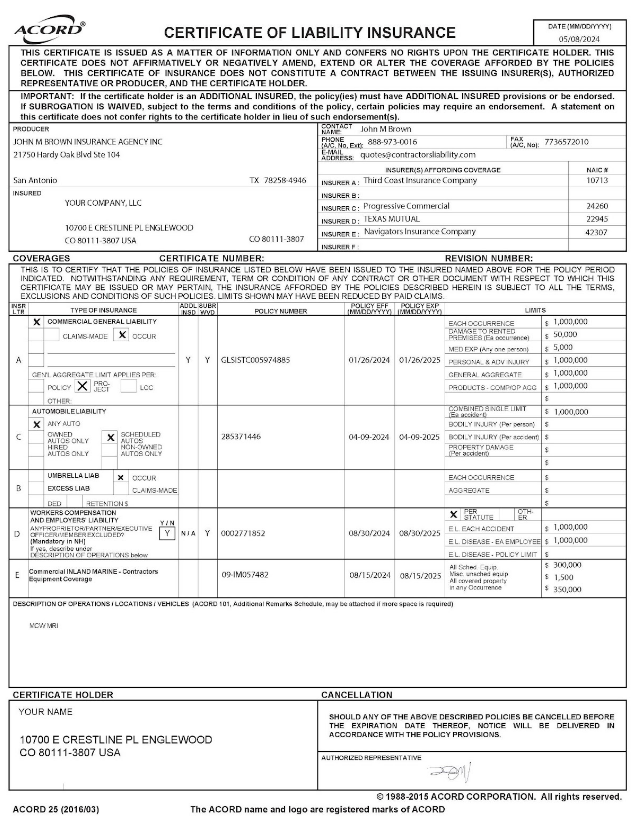
Colorado contractors must meet specific insurance requirements to obtain a license. These include:

General Liability Insurance
Coverage typically starts at $100,000, but higher limits may be required in urban areas or for larger projects. For instance, Larimer County requires $1 million in coverage for Class A and B licenses.

Workers’ Compensation Insurance
Mandatory for contractors with employees, covering medical costs and lost wages for job-related injuries or illnesses.

Commercial Auto Insurance
Required if you own company vehicles, with minimum coverage set by the state for bodily injury and property damage.

Tools and Equipment Insurance
Covers repair and replacement costs for tools and equipment used in business operations.

Commercial Property Insurance
Protects the physical property of your business, covering damages and losses due to events like vandalism.
See the Official Document:
Challenges in Obtaining a License
- Local Variability: The biggest challenge is the lack of a standardized process across the state, requiring contractors to navigate different requirements in each locality.
- No Reciprocity: Colorado generally does not recognize licenses from other states, meaning you must meet all local requirements to work in each area.
Specialized Licensing in Denver
Contact Contractor Licensing
Email: Contr.Licensing@denvergov.org (preferred)
Phone: (720) 865-2770
Office Hours: Monday – Thursday, 8 a.m. – 4 p.m. 2nd floor, 201 W. Colfax Ave., Denver
NOTE: During construction, the contractor licensing counter will be located at the main CPD customer counter, station 3.
Denver’s licensing requirements for general contractors are notably stringent, setting it apart as one of the more challenging cities for obtaining a license. Contractors must secure a Supervisor Certificate, which is unique to Denver, confirming that they possess the necessary experience and knowledge to oversee projects within the city.
Additionally, Denver requires contractors to submit extra documentation, including proof of passing the ICC exam. In some cases, contractors must also pass a local exam that focuses on Denver-specific building codes and regulations. These rigorous standards ensure that contractors operating in Denver are well-equipped to meet the city’s high expectations for quality and compliance.
Frequently Asked Questions (FAQ)
These are common questions about General Contractor License in Colorado.
No, Colorado does not require a state-level license for general contractors. However, most cities and counties have their own licensing requirements that you must meet.
General contractors in Colorado typically need General Liability Insurance, Workers’ Compensation Insurance (if they have employees), Commercial Auto Insurance (if using company vehicles), Tools and Equipment Insurance, and Commercial Property Insurance.
The licensing process is handled locally. Contact the city or county where you plan to work to obtain the specific application forms and requirements.
Liability insurance coverage typically starts at $100,000, but higher limits may be required depending on the location and scope of the project. For example, Larimer County requires $1 million in coverage for Class A and B licenses.
Yes, Denver has stricter requirements, including the need for a Supervisor Certificate, additional documentation, and possibly passing a local exam in addition to the ICC exam.
Most general contractor licenses in Colorado need to be renewed every 1 to 3 years, depending on the local jurisdiction.